Pages

Showing posts with label ConnectedCourses. Show all posts

June 12, 2015

DML 2015: Day One... WOW!!!


So, here I am in this comfy hotel room at DML 2015 on Thursday evening, so exhausted but also excited from the day's events that I decided not to even try to go out to dinner tonight... I'm here in the room nibbling Hob Nobs (THANK YOU, LAURA RITCHIE!), drinking decaf coffee (because seriously, I need to go to sleep sooner rather than later)... but I wanted to write up some notes now, tonight; tomorrow is bound to be full of wonderful stuff also, so I need to write down things from today before heading to bed.

Keynote. The morning's keynote panel with Maria Teresa Kumar and Van Jones, with Craig Watkins moderating, was a perfect start. Hard, in a good way; challenging, in a good way. They are doing such great work and offered some powerful lessons for everybody to take away. Most of all I was struck by Van Jones's remarks at the end, where he talked about people's calling to do this kind of work, where you just can't help it, where you have to be a changemaker. And then he made this distinction between fate as he sees it, the things you really cannot change ... as opposed to destiny, the call to greatness that you might respond to, but it is up to you. I'm thinking that could be a theme that I could use in my classes, and so it got me thinking about having a big theme like that each semester, a way to pull students' stories and writing and their thinking about themselves and their learning into a more general and abstract conversation that we could share with each other, and also share with others. So, mental note: maybe that is the kind of shared-channel type of theme we could use for assignment-building and connection making as Kim Jaxon and Mia Zamora and Kimberley Woo and I were talking about at the #ccourses meet-up. (Note to self: I need to find out if Kimberley is on Twitter!) The keynote was streamed, so you can watch it for yourself at YouTube:


Presentation! Then we had our Open Show panel, and kudos to Alan Levine and Jonathan Worth for deciding not to do a presentation in the usual way, but instead just to have a conversation with people from the audience asking questions and back-and-forth, and so instead of a discussion of tools per se, it was a discussion about teaching and goals and strategies, which is of course the real thing, the kinds of discussions we need to have in order to then find/build the tools we need (and of course people can explore our stuff at the very nifty connectedlearning.tools site that Alan and Tim put together for us). I am really excited about doing some kind of group Known site with my classes next year to see if this can be a bookmarking tool we can use together, and Ben Werdmuller and Erin Richey had some very inspiring things to say about the kinds of problems they hope to solve with Known and the directions that they are going in, and I also got some good ideas from listening to Tim Owens who shared about his experiences both with Reclaim and also from UMW. People from the audience brought up so many important topics, and I am so glad to be connected now with Rudy Blanco and to have learned about the gorgeous portfolios that the students are doing at his school. He's doing an Ignite talk tomorrow, so that will be great for sure! (He's at Dreamyard Prep in the Bronx; I need to find out if he is on Twitter... update: yes he is!) And look at this: beautiful visual notes from Cat Greim!!! How cool is that???!


Chicago: Digital Atelier. After lunch, I went to a really great presentation on a Chicago public school project, Convergence Academies, focusing especially on a Digital Atelier and also on the different ways that the project provided support and development opportunities for the classroom teachers; I was really struck by a Venn diagram showing the intersections of digital media theory, pedagogy theory, and classroom practice and how they were finding ways to find ways to seek out the intersection of all three. There was also a very good and honest discussion about funding and sustainability at the end. Apparently there are these 3-million-dollar DOE grants to support projects like this, but when you go up to the next level of DOE funding, the mismatch between the funding and the program expectations mean that the projects tend to get diluted, making it very hard to move from what sound like amazing accomplishments in the project focused on a few schools to something that is going to reach more teachers and students. Anyway, it was great stuff; I really enjoyed the discussion of how mentoring works in this informal learning space, so that the learning is very much self-directed by the students but with strong support from the staff who are there to help. They take this idea of "constant challenge" very much to heart and apparently even teachers who are were at first very committed to direct instruction ended up being advocates of project- and inquiry-based learning thanks to the opportunities this program presented. Wonderful!

Fan Fiction!!! Next was the Fan Fiction panel... but before that even happened, I had met up with some really nice people from The Harry Potter Alliance in the morning, and just talking with them was really exciting. So, the fan fiction panel featured the research conducted this year by some faculty and graduate students at the University of Washington investigating what they call "distributed mentoring" fan fiction communities, specifically in Doctor Who, Harry Potter, and My Little Pony (which does ... OMG ... have a Doctor Hooves character...!) fan fiction communities. And really, I just have to say WOW... I have never found anything that intersected so strongly with what I do while at the same time giving me all kinds of ideas for new ideas and approaches I might experiment with. I'll save that for a separate post because there is so much to say about that, and I need to do some serious brainstorming to see how I can learn from what these fan fiction communities are doing so well. And yes, it is one of my goals in life to write Star Trek fan fiction... specifically, I want to do an anthology of Aesop's fables as told by the different cultures of Star Trek, so I have purely personal reasons at work here too ha ha. Anyway, the people on the panel were so nice, with great people in the audience also. Just to take one example, I learned about Fold.it - so cool I have to make sure to share that with Cody! 

Ignite! And then, one more set of presentations: Ignite Talks, just five minutes... powerful stuff, and so much stuff squeezed into just an hour: Thursday Ignite Talks. This was also streamed so you can watch for yourself at YouTube (mental note: send this to Randy with link to the part about Chicago kids as city planners!). True confession: I was not keen on the wind-up to get the talks started... but the talks themselves were excellent. They had plenty of energy going on, and we didn't need the random shouting to get that energy sparked.


Connected Courses. And then ... (aren't you exhausted already just reading about it???) ...  there was a Connected Courses meet-up which was really exciting: I had seen Mia Zamora during the day but had not gotten a chance to really talk to her, plus Kim Jaxon was there, and I also met the wonderful Kimberley Woo who is an elementary school teacher. We are plotting and planning, and I am really hoping that some great cross-connections will start happening if we can build some channels to bring our students together in different ways through some shared themes and projects (and with Rudy Blanco also... so many possibilities!). I'm also really hoping I can find some other educators who want to explore Known as a shared bookmarking tool.

So, I am totally exhausted, but in the best way possible. I will go prowl the Twitter stream for a bit to see what I missed from all the other panels that were going on (SO MANY PANELS)... and then crawl off to bed to get ready for more adventures tomorrow. Adam Croom will be presenting about OU's create.ou.edu, Howard Rheingold will be here presenting with Mia and with David Preston (who was one of my favorite people from the Connected Courses hangouts)... oh, so much goodness, plus new things I have never even heard of before too. YES! 


May 16, 2015

Interview with Howard Rheingold

I just got back from out of town with so much to catch up on that I am not even sure where to start — and I'm sharing this with #Rhizo15 too as a promise to get caught up there soon!

First of all, though, I wanted to share this fun interview with Howard Rheingold along with a BIG THANKS to Howard for giving me this great chance to share the things that my students and I are doing at University of Oklahoma. Keyword: FUN! :-)

Teaching The Humanities Online: Blog post from Howard with lots of links and such, and here is the accompanying Vimeo video.


Laura Gibbs from Connected Learning Alliance on Vimeo.

I was so glad to have a chance to do this interview, especially as I will be attending DML2015 in LA in June and getting to meeting lots of new people who are doing great connected learning projects also! You can find out more about DML and connected learning at the DML Initiatives page. Participating in DML Connected Courses last fall was a really important event for me, and I would urge everybody to explore that DML website. It is full of inspiring stuff!


April 30, 2015

Yes, Content IS People: a post for #Rhizo15

Through a series of Twitter coincidences, I ended up having a back-and-forth just now with Gardner Campbell about the readings for Connected Courses. I had to confess that I didn't do a lot of reading for Connected Courses; I tried to keep up with reading the blogs in the blog stream and following the Twitter stream, which is also how I am approaching the Rhizo15 experience, focusing what time I have on reading the blog posts that people share. In fact, my first big Rhizo15 self-assigned task was creating an OPML file of all the blogs I could find both to read AND to share: Rhizo15 Combination Feed in Inoreader. So many blogs!!! And please add your blog if you are not there already!

And then I realized that this is relevant to the challenge for this week in Rhizo15 re: content. There are not assigned readings for Rhizo15 as there were in Connected Courses ... and that is totally fine with me. It's the blogs of the other participants that are really alive and important to me for the purposes of the (un)course experience. Yes, CONTENT IS PEOPLE:


So, at least for me the content emerges in the conversation itself rather than being defined in advance, even tentatively defined in advance by assigned reading lists. That is something that really makes sense to me in an un-course experience, which is how I saw Connected Courses (although I now see from Gardner Campbell that he hoped it would be more course-like) and which is how I see Rhizo15 (which seems very content - conTENT - with being an un-course).

Including some things while excluding others: that is exactly the problem I have with traditional class content, just as Dave emphasizes in the challenge for this week (and by the way, I absolutely love the open-endedness of Dave's challenges... they are totally working for me):


Now, in my own courses, it's . . .  complicated. Unlike Rhizo15 or Connected Courses, my students have not shown up out of sheer curiosity. They have shown up because they are required to take General Education courses, and that is what I can offer: University of Oklahoma upper-division General Education, Western Humanities and Non-Western Humanities, taught fully online. My classes always fill up pretty much instantly because there are a lot of seniors who need Gen. Ed. to graduate, and online is the option that fits everyone's busy schedule.

So, yes, for those courses, I do have to define some content. But my goal is to offer LOTS of choices to the students as the content goes (trillions of choices, ha ha, as I explain here in the introduction to the Myth-Folklore UnTextbook). More importantly, the REAL content of the course is what the students themselves create, as I explain here: The Shift from Teaching Content to ... Teaching Writers.

A big part of what finally prompted me to create the Myth-Folklore UnTextbook last summer was all the great projects my students had done in the past. Working with them on their projects over the years had made me aware of the kinds of stories that really appealed, along with the great public domain resources available to make those readings part of the class. So, I created the Myth-Folklore UnTextbook last summer, and the transformation in my classes this year as a result was AMAZING: students used to have a choice of 2 readings each week in that class, but now with a choice of 16 readings each week, week after week, the energy level was just buzzing, and now by using the feedback I have gotten from the students (they rate each unit), I will be able to add more/better units in the future.

And this summer, I am going to try to transform my Indian Epics class in much the same way (I made that my own Rhizo15 subjective in fact; details here: Summer is Coming). Epics are less modular than mythology and folklore, so it is a challenge... but in a big epiphany in December, I realized that it would be possible to make an UnTextbook in Indian Epics, and I've gotten feedback from students this semester that will help me do a good job with that this summer.

Here's the thing about content, though: even if I do an awesome job, including all kinds of wonderful things for the students to choose to read, I will also be excluding things... but then it will be students to the rescue! Because WITH THEIR PROJECTS the students will be bringing in all kinds of stories and topics that I did not find room for... not because I wanted to exclude any of those stories or any of those topics, but just because I ran out of time/space, or because of my own ignorance.

So, even with the UnTextbook, it will always be the students who are keeping the class alive and wild, going beyond any reading list I could ever create in advance, bringing in the topics and stories they care about the most. And by seeing what they bring to the class, I get better and better ideas of what to put into the UnTextbook. And around and around we go, in a circle of reading virtue!

Read on! Write on! RIGHT ON!!!!!!

And thanks to Gardner for prompting me to quickly write up this blog post tonight. I've got some ideas in here I need to unpack in more detail... but it's a start. :-)

March 28, 2015

DML2015: Here I come........!!!!


So, here is some big news: for the first time in ten years (!), I am going to a conference — DML (Digital Media and Learning Research Hub) in Los Angeles, June 11-13. Hashtag: #DML2015.


Here is the conference site: dml2015.dmlhub.net

And the main DML site: dmlhub.net

I got to know some of the DML folks thanks to the fabulous experience that was Connected Courses in Fall 2014 (#ccourses).


When Alan Levine contacted me and asked me to be on a panel along with some other fabulous people, I obviously could not say no (Alan Levine!!! my hero!!!), and then it was really exciting when we found out the panel was accepted (long wait; I was thinking we had not made the cut).

Then, even more exciting, I got some funding from my school for the travel, thanks to the VERY NICE people in the Arts & Sciences Online Course program and to our wonderful Dean (yes, he's on Twitter!). That was a huge surprise; going to a conference is insanely expensive (eegad, the hotel, it makes my head hurt), so it really makes a huge difference to have my school's support in doing this!

In future posts I'll have more to say as I get ready for the conference, learn more about all the good work the folks at DML are doing, and on and on. It is going to be really fun to meet some people I have known only online, including people like Alan whom I have followed for over a decade online but whom I have never met in person. The whole Connected Courses experience last fall was such a great experience, and I am looking forward to DML goodness in June! :-)


March 12, 2015

OpenTeachingOU: An Open Friday Twitter chat!

I'm creating this post today, Thursday, to brainstorm some ideas and strategies for a Twitter chat fest that Rob Reynolds, Stacy Zemke and I will be enjoying on Friday morning, March 13, at 9AM Oklahoma time (and that's 10AM for me in NC)... hopefully with the participation of others also. Rob's got a Google+ post here to get the ball rolling! We'll be talking about open education in general, and specifically our experiences with open education efforts at the University of Oklahoma.

Yes, I know it is Friday the 13th!!! But we won't let that get us down! :-)

I've volunteered to Storify the event afterwards, and we'll be using the #OpenTeachingOU hashtag, along with whatever hashtags emerge. We were prompted to do this in honor of Open Education Week, and that hashtag is #OpenEducationWk with the related #AllAboutOpen tag. And the #OER hashtag is always hopping!

In addition, I've set up a publicly editable GoogleDoc where we can use to store and share stuff that doesn't fit in a tweet: OpenTeachingOU Google Doc. If this turns into a recurring Twitter event (I hope it will!), we can use this document, or a series of such documents, as an ongoing repository across multiple events.

I'm not sure if we want to run this like an organized type of Twitter chat with Q1 Q2 and so on, with people responding A1 A2, etc., but it might be good to give that a try just so that we behave! If we swap questions out every 10 minutes, that gives us time for a half-dozen questions. (More ideas and tips for Twitter chats.)

Here are some I would suggest, and hopefully both Stacy and Rob will chime in with ideas about that. I'll be glad to watch the clock and tweet out the questions at 10-minute intervals if we decide to try to be that well behaved, ha ha. How do these questions sound?

Q1 How is "open" important in your work as an educator today?
Q2 Who are some of your open heroes and heroines?
Q3 How has your own open presence online evolved over time?
Q4 What specific problems can the open approach help us to solve?
Q5 What can we do to promote open education at the Univ. of Oklahoma?
Q6 Do we want to keep using Twitter chat for more open-fests?

Later today, I'll make up a new Twitter list of people doing open-related work at OU; I've got a huge Twitter list for OU faculty/staff and OU programs, so I'll run through those looking for people who are using blogs, websites, Twitter, etc. to share their teaching and learning, and I'll let them know about this chat. Meanwhile, if you have people to suggest for that list now, let me know! Just tweet me (@OnlineCrsLady) with their names and Twitter handles. That will be great!

Okay, here is first run at a Twitter list: OpenTeachingOU Twitter list. I'm sure there are lots of people I have forgotten... let me know! :-)

SEE YOU FRIDAY AT THE TWITTERS :-)


Leave comments here at the blog, at the Google Doc, or over at Google+. Here's the Google+ post embedded:


March 8, 2015

Be Prepared! Online Courses on Autopilot

I've been out of the loop for the past three weeks as you can see and, sadly, it is because of a family emergency: my mother, who was on hospice care, died last week. I've started a separate blog about that, both to work through the hard times of the past few weeks and also to share with others what I learn about death-with-dignity legislation: Morituris Omnibus. I've always felt strongly about each person's right to choose the manner and time of their dying, especially when facing medical calamities like my mother was facing; now that cause is much more urgent and personal, and I will be using that blog to share my involvement in this movement for change in our medical and legal systems.

Meanwhile, in this blog post for #OpenTeachingOU, I want to share what I learned about my online course design and how in some ways it was flexible enough to accommodate my sudden and unexpected absence, although I now know that I should also make some improvements for the future.

Communication. By relying on the class announcements blog along with emails, I was able to keep all the students informed about what was happening. That felt very solid; I don't think I need to make any changes there, and I was incredibly grateful to the students for their patience and understanding during this hard time. Of course, if I were really out of action completely, I would need the director of the online course program to communicate about that to my students; see note below about planning for a really serious emergency like that.

Assignment Readiness. This was the main problem I need to fix. In the past, I used to have all the assignments 100% ready to go before the semester started, but over the past two years I have been tinkering with my classes a lot, which means I have been writing up some assignment instructions and declarations during the course of the semester so that I could be really responsive to student suggestions and feedback. To accommodate emergencies like this in the future, I need to be more careful. Before the semester starts I need to have every assignment ready to go; that doesn't mean I cannot tinker with them and improve them. Instead, it just means that in case of an emergency like what I faced this semester, I would not have any doubts about the students being able to carry on in my absence. Because I did have some Internet access during this crisis, I was able to get the assignments ready this time — but in a different kind of emergency (if I were in the hospital or something myself), the students would have been missing some of the assignments that they needed.

Project Feedback. The bulk of my time each week (appx. 30 hours) is spent giving feedback to students, and the week by week assignments are structured such that the students have my feedback from the previous week in time to do their work on the next week's assignment. Over these two weeks, however, I was not able to keep that up given my limited Internet access. Out of the appx. 160 projects students turned in while I was gone, there were 25 where I could not write my reply in time, so I gave those students an extra free pass for that assignment. This strategy assumes, of course, that I have Internet access. If I were completely out of the loop, I would need a different strategy so that the students could keep on working ahead to develop their project, while postponing all the revision work until my return. So, I need to write up a kind of "emergency plan" which will explain to the students how to carry on doing the work for their Projects in my absence, catching up on the revision process later.

Administrative Coordination. I contacted the director of our online course office when I had to leave town to let her know what was happening, and because I did have some Internet access, there was really nothing that she needed to do or worry about. If, however, this had been an emergency where I was incapacitated, it would have been very hard for her to figure out what needed to be done in my classes, especially if the emergency were to occur at the end of the semester when grades are due. So, at the beginning of each semester, I need to write up an "emergency plan" not just for my students but also for the online course director so that she would be able to easily manage any emergency that might come up at any time during the semester. Besides the Projects, everything in the course is ready to run on its own, student-driven, in my absence. Even in a really dire emergency (if I were kidnapped by space aliens in Week 2 of the semester, for example), the courses would still be viable. Not optimal — but viable!

Overall, I am really pleased about how my classes are very much the result of the students' own work and their interactions with each other. So, while I am definitely a hands-on instructor, heavily involved with my students' work every week, my classes really can survive a disruption like this — and what a big relief that was over the past two weeks! I am very grateful about that: it meant that I could hang up the phone with hospice and immediately go online to get a plane ticket without a moment's hesitation, knowing that my students would be fine without me. At the same time, this is the first ever emergency I've faced in 10+ years of teaching online that meant I had to be "absent" from class for more than a just a day. So, I learned a lot from the experience, and I will be sure to do a better job in future of making my classes emergency-proof.

Yes, we can all use the help of Otto the Auto-Pilot in case of an emergency!


And here's an Airplane click featuring Otto at work:

February 15, 2015

February 15: OpenTeachingOU News Update

So, for the #OpenTeachingOU round-up this week, there is some FABULOUS stuff to report. What a great week! And for more, check out the #OpenTeachingOU Omnifeed (thank you, Inoreader!), and also previous news round-ups.


OU Folks

Rob Reynolds, NextThought CPO. Given OU's ginormous investment in NextThought, I thought this should count as "OU Folks," especially since I am so happy about it: Rob Reynolds is now Chief Product Officer at NextThought, and we can see his work already taking effect. They have a real website now, and a real blog!


Faculty Learning Community: Online Presence and Digital Identity. I was THRILLED to see that the upcoming FLC from Adam Croom already has a web presence of its own! I hope to join in even if I cannot participate in the face-to-face.


Domains Do Disney. Adam was also at ELI this week and shared this fantastic blog post with an update on create.ou.edu. There are some faculty blogs here I have to explore, so expect more goodness here in the OU section next week!


Faculty Learning Community: Teaching in a Digital Space. Another great FLC, and one that I hope will leave a digital trail also. Kevin Buck says he will blog it! Yes!!!!!! We need some good Kevin energy for D2L... the John Baker webinar was not exactly a toe-tapper this week (maybe others got something out of it; I listened attentively but had nothing to take away).


President Boren on Twitter. Yes, President Boren has a Twitter account now... so, thanks to the power of the Twitter widget in D2L, President Boren was there to greet my students when they logged in!


Beyond OU

Striving for a Pedagogy of Empowerment: Taking a Leap of Faith. Beautiful piece from Mia Zamora: "A truly wise person learns from every person he or she connects with in the most unforeseen moments. This is of course the soul of co-learning. And, perhaps it is also the seed of equity and justice."

Educators as Lead Learners. More on colearning and making learning visible, this time about our learning as instructors, from Jackie Gerstein, with a great graphic as always!


U.S. Postsecondary Faculty in 2015. This Gates Foundation report has some very discouraging numbers re: faculty and technology but the report itself had some glimmers of hope compared to the short write-up I read in the Chronicle of Higher Ed. (Thanks to Phil Hill for alerting me to check out the actual report.)

NMC Horizon Report. Great comments from Stephen Downes: "So what does it tell us about the methodology? Mostly, that it sways in the breeze. It's strongly influenced by the popular press and marketing campaigns. It's not based on a deep knowledge significant technology developments, but rather focuses on surface-level chatter and opinion. And that is why I think NMC should be obligated to re-examine its methodology."

Before You Assign That Homework — What Students Wish You Knew. Great post from Pernille Ripp with much for higher ed here too. I am esp. a fan of the strategy that we should be doing our own homework.

Critical Digital Pedagogy. Beautiful and very thought-provoking slides from Jesse Stommel.


My Stuff

Ugh: That Grading Article in Chronicle Vitae. Terrible and depressing article, but at least it led to a good conversation re: very important topic of grading.

Data Schmata: Midterm Grade Reports. Yep, no comments. Again. It's big data deja vu all over again!

Making Learning Visible: Power of Past Student Work
. Preliminary report on the way availability of Portfolios from last semester is changing things BIG TIME in my classes this semester; I'll have more on this next week.


Pinterest Project Boards. Excited to have Pinterest Project Boards running now, and I embedded them in the Project Directories for both classes!


Student Project Comments. Exciting week coming up: students begin commenting on each other's projects. I've revamped that assignment and am hoping for even better things than in past!


Student Schedule Update. I'm continuing my "small data" project for the semester, seeing what more I can do to get students to develop their own schedules instead of doing work based on my (arbitrary) deadlines.

Inoreader Dashboard. I am so happy with my new strategy for using Inoreader's Dashboard options!


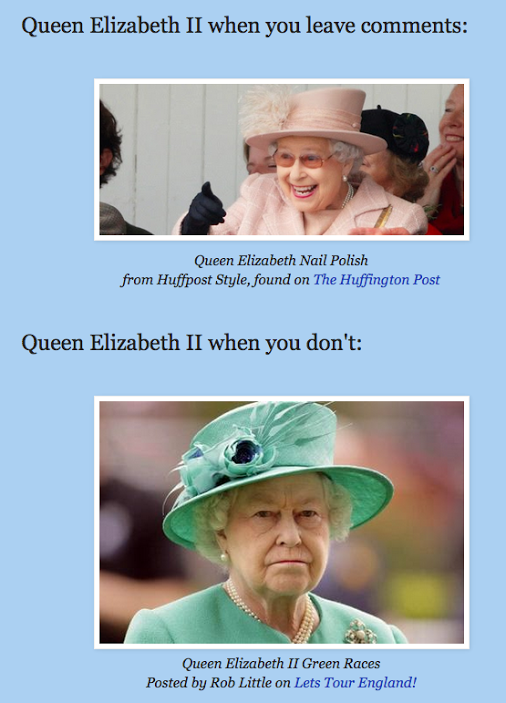
Comment Walls. Some students come up with fun graphics for their Comment Walls (they are setting up those Comment Walls this week, getting ready for comments to come). Here's one that is very fun indeed:


February 8, 2015

February 8: OpenTeachingOU News Update

So, I feel all the more strongly about my #OpenTeachingOU experiment after reading the Babson report this week. If the majority of people in higher ed still believe that online courses are not "legitimate," then those of us who KNOW otherwise need to share what we know as openly and as widely as possible. So, I will carry on with #OpenTeachingOU as my hashtag at Twitter,while also collecting #OpenTeachingOU from Google+ and my blogs over at the #OpenTeachingOU Omnifeed. (Thanks, as always, to Inoreader for that fabulous tool!)

Below is my #OpenTeachingOU round-up for this week, and you can find previous round-ups here too. I am really pleased that I managed to tag at least one item every day this week, and the beginning-of-semester rush has settled down, so I can hopefully start reading more widely. I am badly behind on people's blogs, but blogs are patient: in the coming week, I will try to catch up on some of my favorites.


OU Folks

Youth Community Informatics Studio. Wonderful, very informative blog post from Colin Rhinesmith about his new community-engagement course, "Leadership in Information Organizations" where they are working with the Moore Public Library. It sounds exciting!


Adentures in Digital Humanities. The open set-up that Katherine Pandora is using for this "dream course" means there are new things we can all see and learn about every week. The group blogs, for example, are up and running!

What is Your Motivation for Learning? Very useful post from College of Liberal Studies about students and motivation. I like the idea of thinking about motivation from different angles... because it's true: different students are differently motivated, as are teachers too of course!

PRPubs Pinterest. At Twitter Adam Croom shared a Pinterest project that is part of his PRPubs class.

I would be glad to know of other examples of open teaching going on at OU this semester!


Beyond OU

Bad News for Online Learning in Annual Report & “Unsustainable” MOOCS are Full Steam Ahead. You will find lots of write-ups of the Babson report data, but the one that got to the issues that most concern me is this post from Debbie Morrison.

Online Teaching: A New Beginning. And here's a nice counter-point to the Babson report: a guest post at Michelle Pacansky-Brock's blog about an online instructor's explorations and discoveries.

What Are Your Favorite Faculty Development Blogs? I was so glad to see Debbie Morrison and Michelle Pacansky-Brock on this list from the Chronicle's ProfHacker blog, and I look forward to exploring and finding more!

Desperately Seeking the Unique Pedagogical Characteristics of Face to Face Teaching. Excellent post from Tony Bates turns the Babson report upside down: instead of asking online to prove itself, he is asking defenders of face-to-face to please explain just what exclusive claims they have to teaching efficacy. 

Coursera Sets Sights on Universities. Yes, the megalomania at Coursera never stops: they still want us to believe that their courses are so good that universities can use them instead of teachers. I kid you not. No need for in-house expertise. Just buy Coursera. Ka-ching.

Instructure Releases 4th Security Audit. This is not about teaching but it is a nice write-up from Phil Hill about the importance of transparency, and I think it is no accident that Instructure is being transparent about its security audits, just as Instructure built an LMS that allows instructors to decide whether their content is open or not.

Ford Foundation, Open Access and Really Sharing Knowledge. Excellent post from Nancy White about openness, something to read together with Phil's Instructure post above. As I see it, the closed design of D2L, where instructors cannot share their teaching or their teaching materials even if they want to do so, is probably the single biggest barrier to our pedagogical progress. So, again: another reason for #OpenTeachingOU. We've got to get out of the D2L lockdown and start sharing more online!

Does It Matter Whether Students Recognize What We Do As Teachers? This post from Pernille Ripp also reinforces my sense of why OpenTeaching is so important: it matters to our students too, perhaps more than any other audience! 

What if Contentment is the Answer? Beautiful post from John Spencer about how contentment can lead to more and better risk-taking: confidence, not complacency.

How Medium Is Building a New Kind of Company with No Managers. Lots of good analogies for education here: this reaction against dehumanizing styles of business management would also work very well as a reaction against dehumanizing education styles as well.

Engagement: I Do Not Think It Memes What You Think It Memes. Very thought-provoking post from Terry Elliott about engagement as something that must be reciprocal and not just stimulus-response (a bit like my post about interaction from last week... but with better memes, ha ha).


My Stuff

Storytelling Posts. I really like being able to share the student blog posts in a dedicated stream; this week I shared the stories coming in from the Myth-Folklore class. I also shared their reading diaries, and it is the stories in those diaries that provide the raw materials for their storytelling later in the week. Coming soon: the Storybook websites are taking shape for this semester, as are the Portfolios!

Spring 2015: Grace Period Reminder Tracking. This is the blog post where I'll be providing an overview of my "little data" experiment for this semester, trying different interventions with students who are chronically late with work for class. The post is updated now for Weeks 3 and 4.


And as an image this week, I wanted to share this great painting of a "colporteur" (17th-century France).  It showed up in one of the book-oriented Twitter feeds I follow, and I thought it was beautiful: I feel like a colporteur for my students, singing the praises of the books... but the books I offer are free! Whoo-hoo! Long live the public domain and the open Internet!


February 1, 2015

February 1: OpenTeachingOU News Update

So, as last week, I'm using my #OpenTeachingOU omnifeed to pull together my teaching/learning highlights for the week! It would be so great if more people at OU started using this hashtag to share their teaching practices in an online conversation, but even just as a tag that I use for myself to put tweets and posts into a dedicated stream, it's very useful! (And here are my previous news round-ups.)


OU Folks

Katherine Pandora. The big open teaching news this week at OU was all the great sharing that happened via Twitter because of Katherine Pandora's dream course and the visit by Michael Peter Edson from the Smithsonian. You can follow Katherine at Twitter for more goodness to come, and, even better, you can visit the open class site: adventures in digital humanities.


Stacy Zemke shared this photo of the event via Twitter:


Beyond OU

Are Schools Failing Extroverts? Great post from John Spencer on extroverted students. As an "ambivert" (ha ha), I really appreciate how the online environment can be GREAT both for extroverts and also for introverts!

FUN: The One Thing We Forget to Plan For. Wonderful post from Pernille Ripp about fun. Sadly, so much of college teaching proclaims its rigor. I vote for fun! "Learning should be fun. Curiosity should have a place in our classrooms. Laughter should happen on a regular basis. Smiling should be a classroom rule. Fun should be one of the many pillars that supports all of the learning that we do. It should be embraced, discussed, worked on and celebrated. Schools should be filled with fun."

Questions to Ask Oneself While Designing Learning Activities. Such a great post from Jackie Gerstein and, yes, fun is one of the questions!


Helping a Perfectionist Child Worry Less and Do More. From Jessica Lahey at New York Times - I would guess that perfectionism is probably the single biggest barrier to changing how we teach... and it's also the biggest barrier to Open Teaching I suspect. A lot of academics don't want to share things openly that are less than perfect. That's not a problem for me, ha ha — I'm a recovering perfectionist, and my recovery is going very well.

A New Twist to Teaching Online: Considering Learners’ Emotions. Great post from Debbie Morrison. The emotional factor is HUGE in my opinion, which is why I find the idea of teaching machines laughable (and computers don't get the joke either). Debbies includes this very nice graphic from Rienties and Rivers:


10 Things the Best Digital Teachers Do. From Jesse Stommel over at Chronicle Vitae (which does NOT have RSS, alas)... a very good list! I esp. endorse this one: GRADE LESS. Or, even better, not at all; here are my thoughts on grading.

High Impact Online. Although I was dismayed by the idea that someone as savvy as Matt Reed had no idea what would be a high impact practice online, people chimed in with lots of ideas. I even left a couple comments there because this is such an important topic. As a result of a follow-up convo at Twitter with Debbie Morrison, I learned this great acronym: HIP, high-impact practice. I want to be an online hippie, ha ha, a "high-impact practitioner."


My Stuff

What Professors Actually Do. My response to Scott Walker of Wisconsin: if we practice OPEN TEACHING, then people would have a much better idea of what professors actually do. Especially those of us (instructors, not professors) who teach full-time!

The Potential of Online Education. Thoughts on face-to-face workshops. I just don't see how we will become confident and skilled at helping students to learn online if we continue to do all our learning in small, face-to-face groups. At my school, we are well into the second year of a big "Digital Initiative," but I have yet to see anything like a community of practice or learning network emerging for those of us who are committed online educators, eager and ready to share ideas, experiences, etc. The learning opportunities we offer faculty are all face-to-face, not online. For why this matters, see next item:

Course Evaluation Data: We're Skewing Low, Not High. And here are some numbers that demonstrate WHY those of us who are teaching online need to be sharing our ideas and experience: the course evaluations for online courses in my college skew low rather than high. In my opinion, the incredible potential of online education would mean the numbers should skew high, not low... but that is not going to happen until online instructors themselves start sharing and learning together online IMO.

Interaction Entre Nous... NOT Machines. My thoughts on the word "interaction" as prompted by a thought-provoking back-and-forth with someone in my campus's IT department.

New "Comment Training" Strategy. I am SO HAPPY with how this "Comment Training" experiment is going so far. It's something I wish I had done years ago in my courses!


And to close... here's a wonderful graphic making the rounds on Google+:

Change. If you don't like change, you're going to like irrelevance even less.


January 31, 2015

Interaction Entre Nous... NOT Machines

This blog post is prompted by a back-and-forth I had via email with a really nice person in my campus IT who wrote to ask me what I thought about a particular elearning authoring vendor. I wrote back to say that I didn't think much about the vendor (Versal) one way or another because authoring content was not something that interests me. Instead, I am much more interested in my STUDENTS as authors and designing classes in which the goal is to enable and encourage the students to be creating new, original content as part of the class. As a result, I think my time is better spent helping the students to create content, as opposed to creating content myself.

And here's what prompted this blog post: the very nice IT guy wrote back and said, "I think your focus on the student is correct although I've had at least a few faculty approach me with an interest in making their lessons more interactive."

ALARM BELLS RING: Interactive... do we all agree on what that word means? Clearly not.

To me, interactive means human beings interacting with each other. Inter-action. You do something, I do something that is somehow connected to your action: we are inter-acting. It is something that humans do together, and it requires humans to do that. Or, okay, cats. My cats are definitely interactive; they interact with me, they interact with each other (not nicely, alas).

But I do not believe that computers can interact with humans. We can use computers for all kinds of purposes, and one purpose of a computer can be to facilitate interactions with other human beings . . . like right now: I write something in a blog, and if you are prompted to comment here, and I comment back, glory hallelujah: we will have interacted, even if we have never met face to face.

But I am not prepared to use the term "interaction" for a computer's action in response to something that I have done. There is NO ONE THERE to interact with. If you say a computer is interactive because it makes a happy bleep when I answer a quiz question correctly would be like saying that Rice Krispies cereal is interactive because it goes "snap, crackle, pop" when I pour milk on it. Or like saying that the door to my house is interactive because it opens when I turn the key. And so on, ad infinitum ... and ad absurdum.

So, yes, it is essential that learning be interactive: we need human feedback of all kinds to keep our learning process moving forward. Making my online classes highly interactive is a primary goal for me. Just today, I wrote up notes on an important new strategy I am trying to improve the student-to-student interactions in my classes: New "Comment Training" Strategy.

But that does not mean I need an elearning vendor to sell me some product to create so-called "interactive" quizzes, etc. (scare quotes intended). Instead, I am interested in products that facilitate person-to-person communication online. Right now, for my classes that means mostly blogs and Twitter, along with that vintage standby: email. (I far prefer blogs and Twitter.)

So, what say ye, people? Has the word interactive become so empty of meaning that online quizzes now qualify as an "interactive" component of a class? Was the word "dynamic" not good enough? If so, heaven help us. It means I will have to find a new word to use for what I consider real interaction, if that word has indeed been kidnapped and emptied of meaning by the elearning vendors.


January 20, 2015

Hashtags for curation: Saved by #OpenTeachingOU

Well, it is time to pause and say: WOW!!!!!!!!! The semester has gotten off to a fantastic start for me. I am seriously overenrolled in my classes (usually about 10% of people who are enrolled drop, and I plan on that... but, yikes, that has not happened this semester, so I am still at over 90 students right now)... but thanks to Inoreader and other improvements in my work flow, I think I should be able to cope. And it is going to be so exciting having all these people blogging, writing stories, sharing ideas. So many great students as always.

But........ BUSY. That overenrollment is definitely going to eat into the time I might normally have available for blogging and stuff.

Which is why I am so glad that I started using the #OpenTeachingOU hashtag.


In honor of Jim Groom and the Academic Tech Expo we had here earlier this month, I started using an #OpenTeachingOU hashtag at Twitter, at Google+, and also at my blogs, hoping that might be a way for those of us who are into open teaching to connect up with one another. That has not happened yet (although there was a seriously awesome post from Adam Croom in that spirit!) ... but even just using the hashtag for MY OWN CURATION has proved really useful. I haven't had any time to do any posting at this blog for the past week or so, but the #OpenTeachingOU hashtag does provide a glimpse into what I am thinking about and how things are going this semester so far!

I've created an #OpenTeachingOU OmniFeed page which shows all my posts with the tag (Google+, Twitter, blogs... and Pinterest too... although I don't think I've pinned anything for open teaching yet), and you can also see a standard Twitter hashtag widget in the sidebar of this blog. Isn't that cool? I love the way I can create these "omnifeeds" with Inoreader thanks to their Google+ and Twitter integration!

So, for those of you who are not interested in my Latin LOLCats and stories from India and random blah-blah-blah-whatever that shows up in my feed, the #OpenTeachingOU Omnifeed is for you, ha ha. It is a glimpse into my teaching eurekas... and a promise of blog posts to come.

Hashtags: they are powerful!

And I saw this infographic about history of hashtags thanks to Ian O'Byrne over at Google+ today. To be honest, hashtags kind of suck at Google+ (even if I am one of Google+'s biggest fans)... but I do use #OpenTeachingOU there too, in hopes that Google+ hashtag culture might improve.

And someday........ someday.......... I will get up on all the posts I am behind at this blog, ha ha.


January 10, 2015

Ten Reasons for Week Zero (a.k.a. Soft Start)

So I just had such a nice week!!! It was "Week Zero" of the semester; in other words, classes start officially on Monday (Jan. 12), but I opened up my classes a week early (on Jan. 5) so that people who wanted to get a head start could do so. This is something I have always done from teaching online, from the very first semester back in 2002. I recently posted here a list of Ten Reasons for Orientation Week, so I thought it would be good to do a list of Ten Reasons for Week Zero (a.k.a. Soft Start).

1. Helping students get ahead. Working ahead is one of the best strategies for any class, and that is especially true for online classes. It is consistently the top advice that students recommend to future students, as you can see here: Peer Advice - Time Management. Having the classes open in Week Zero is all about getting ahead!

2. Taking advantage of slack time. Once students' other classes start, I am competing for their attention. Because I teach Gen. Ed., my class is understandably not a high priority for many students; classes for their majors must come first. So, if I really do want these students to get ahead (see reason #1), then taking advantage of the slack time before the official start of the semester is really important!

3. Making sure students know what they are getting into. Not all classes are a good fit for all students. My classes, for example, are writing-intensive, which is not something students expect from a Gen. Ed. class. By opening up the class early and encouraging students to give it a try or at least to see the course materials/assignments, they can see what they think. If they decide to drop, they will obviously have a better chance of finding another class to add instead if they are looking in Week Zero as opposed to looking for an open class in Week One or, worst of all, in Week Two, when you can only add with instructor permission.

4. Checking to see if the courses really are ready. I am so grateful to the students who alert me to broken links, instructions that are not clear, etc. The more I tinker with the courses (and over this winter break, I tinkered way more than I usually do over winter break — there were just so many good ideas from students last semester that I wanted to try out!), the more likely that there will be typos, broken links, etc., that I need to fix. I really depend on the pioneer students during Week Zero to help me find the things I need to fix!

5. Refining Inoreader folders, rules, and labels. By having incoming blog posts from the students, I am able to make sure my Inoreader folders, rules, and labels are going to do what I need them to do. Last semester, I found Inoreader too late to do a really efficient job with the rules, but I learned a lot from my mistakes in order to set things up more efficiently this time. Of course, I thought I had it all figured out... but when actual student blog posts started coming in this week, I realized lots of little tweaks that would help make my folders, rules, and labels work even better. I need actual student blog posts in order to match the workflow to reality!

6. Bringing the class blogosphere to life. Not only do the live blogs help me in configuring Inoreader, it is also a big boost for the students who who will be starting the class next week: they can see the posts that students wrote in Week Zero, and seeing actual examples of the assignments is just as important as the instructions I provide. Indeed, for some students, it's even more important because they might just skim the instructions, getting their real sense of how to do the assignment by looking at the work of others. Thanks to Inoreader's rules and feeds, I can automatically share those assignments; here, for example, is the first blog post assignment: Favorite Place(s). I love the way it updates 24/7 automatically as the blog posts come in!

7. Getting to know the students. I love the way I have time to read and respond to all, or almost all, of the blog posts during Week Zero. That is less true in Week One, and then in following weeks, it's the students replying to each other mostly, with the blogs being more "their" space in the class while I focus on their projects. During the soft start, though, I have a chance to really get to know the students who start early, reading all their work, getting a sense of who they are, their goals for the class, etc. It is always such a pleasure: my students are a fascinating bunch, and I really like having time just to get to them know them in a more leisurely way during Week Zero. This week during Week Zero, appx. 40 students set up their blogs (but not all of them have started posting in their blogs), and I made 87 comments on actual blog posts.

8. Setting up lines of communication. When I release the classes to the students, I start using the different channels of communication that we will be using all semester long, so the students can begin getting used to that, even if they aren't doing work for the class. So, I start posting in the Announcements blog, I revive my class Twitter feed, I start pinning regularly to my class Pinterest Boards, etc. In most of the classes at my school, the focus is 100% on D2L BS (our course management system), but for my classes, D2L BS is not important at all for the content or communication in the class, and I want the students to be aware of our Class Announcements blog, the different websites I use the class, etc. So, the emails I send them about the soft start are not lengthy emails. Instead, they are just a few key links to get them started — link to the Class Announcements blog, link to the class websites, etc. Not D2L.

9. ENTHUSING. One of the most important ingredients for success in my classes is enthusiasm: the students' enthusiasm and my own enthusiasm combined. By starting the classes early, I can demonstrate and share my own enthusiasm with the students, hoping to be a catalyst for some enthusiasm on their part — and my enthusiasm for these classes is ENORMOUS... even though I have fun during the school break, I am always so excited to get back to work and make sure the classes are ready to go.

10. Getting myself into school mode. I love my job, but I also love the holiday vacation. I stay up too late, watch too much Netflix, read mountains of stuff, start new projects, indulge my own obsessions without restraint. Luckily for me, some of those projects and obsessions are school-related, but there's still a HUGE difference between my daily routine when school is in session and when it's not. Having the soft start is a way for me to make that transition so that when the craziness of Week One arrives, I am ready for it! Well, sort of, ha ha.

... yes, I do get up early when school is in session! Here is a rhyming Latin proverb on that subject.


(Latin: Est sanum plane de lecto surgere mane.)


'


#OpenTeachingOU 

Update on #OpenTeachingOU Hashtag: Happy!

So, just a quick post here to say that I am really happy with this hashtag I have started using, #OpenTeachingOU. Given the hectic time at the beginning of the semester, with all the work I'm doing to get ready for classes, I haven't had time to be keeping up with my news rounds-ups, etc., but the #OpenTeachingOU hashtag is a way that I can label tweets and posts and items at Google+ so that they don't get lost in my online space which is full of teaching stuff, yes, but also full of LOLCats and Indian images etc. etc. So, the hashtag is proving to be a really good way for me to think about open teaching as I participate in these online spaces each day, and that is a good thing to be thinking about!

I'm also REALLY grateful to know about the ClassicRetweet extension for both Chrome and Firefox since that allows me to add the hashtag when I retweet. :-)

Of course, most of all I am hoping... especially after Jim Groom came and worked his magic at the Tech Expo on Friday... that the #OpenTeachingOU hashtag might catch on! There are all kinds of people and programs at OU that are moving, slowly or quickly, in the direction of open teaching and connected learning, so in addition to just using it for my own curation purposes, I'll also keep hoping that the hashtag will serve a more social purpose too.

Below is the HTML clippings feed for the #OpenTeachingOU hashtag via Inoreader (see it on a page of its own ... and here's the RSS). That's a bit different than the widget in the sidebar of this blog: in the sidebar, you are just seeing the Twitter stream for the hashtag, but Inoreader is pulling anything with #OpenTeachingOU, which means all the blogs I am subscribed to, plus my Google+ stream, along with Twitter. Inoreader searches through all that stuff with a rule I created, and then it combines the matching results into a new consolidated RSS feed.  Plus, I can add that label manually to items I find in Inoreader myself if I want to pull them into the RSS feed for OpenTeachingOU. So powerful! I am really enjoying the different uses I find for Inoreader, and this is a good one. :-)


January 6, 2015

A fun first day with #OpenTeachingOU hashtag

Hashtags are one of my favorite things about Twitter. They are great for indexing AND great for connecting. I'm not sure if it will be possible to get #OpenTeachingOU to really work for connecting people at OU (there are just not that many OU faculty using social media, alas...), but even if it is not something that takes off in a social sense, I realized yesterday how useful this can be for me simply as an indexing strategy.

#OpenTeachingOU

Here's what I mean by that: as I tagged my own content yesterday and also used #OpenTeachingOU when I retweeted and shared at Twitter and at Google+, I was able to focus more clearly on what part of my content stream is about open teaching. Open teaching is something I care about very much, and it can go in so many different directions: open syllabuses, open educational resources, sharing narratives about our work as teachers, sharing our students' work, and on and on. Connected Courses really affirmed my commitment to open sharing online, so I will be hoping good things for open everything in 2015!

In particular, I'll keep hoping good things for online conversations about teaching at OU in the new year (more about that here in my previous OpenTeachingOU post), and I'll also enjoy having the #OpenTeachingOU hashtag as a way to index my own blogs and tweets and posts.

So, after Day One, here's how it is looking at Twitter: #OpenTeachingOU ... and thanks to the power of Inoreader to turn all kinds of things into a feed, you can see even more via the Inoreader RSS or the HTML display for the tag! I've embedded that HTML view below. Just click on the title of any item, and away you go!

Next: I need to add a Twitter widget for this hashtag to this blog's sidebar. Hashtags! Widgets! RSS! Connect and share everywhere! Yes!!! :-)