Pages

Showing posts with label OUCTE. Show all posts

March 12, 2015

OpenTeachingOU: An Open Friday Twitter chat!

I'm creating this post today, Thursday, to brainstorm some ideas and strategies for a Twitter chat fest that Rob Reynolds, Stacy Zemke and I will be enjoying on Friday morning, March 13, at 9AM Oklahoma time (and that's 10AM for me in NC)... hopefully with the participation of others also. Rob's got a Google+ post here to get the ball rolling! We'll be talking about open education in general, and specifically our experiences with open education efforts at the University of Oklahoma.

Yes, I know it is Friday the 13th!!! But we won't let that get us down! :-)

I've volunteered to Storify the event afterwards, and we'll be using the #OpenTeachingOU hashtag, along with whatever hashtags emerge. We were prompted to do this in honor of Open Education Week, and that hashtag is #OpenEducationWk with the related #AllAboutOpen tag. And the #OER hashtag is always hopping!

In addition, I've set up a publicly editable GoogleDoc where we can use to store and share stuff that doesn't fit in a tweet: OpenTeachingOU Google Doc. If this turns into a recurring Twitter event (I hope it will!), we can use this document, or a series of such documents, as an ongoing repository across multiple events.

I'm not sure if we want to run this like an organized type of Twitter chat with Q1 Q2 and so on, with people responding A1 A2, etc., but it might be good to give that a try just so that we behave! If we swap questions out every 10 minutes, that gives us time for a half-dozen questions. (More ideas and tips for Twitter chats.)

Here are some I would suggest, and hopefully both Stacy and Rob will chime in with ideas about that. I'll be glad to watch the clock and tweet out the questions at 10-minute intervals if we decide to try to be that well behaved, ha ha. How do these questions sound?

Q1 How is "open" important in your work as an educator today?
Q2 Who are some of your open heroes and heroines?
Q3 How has your own open presence online evolved over time?
Q4 What specific problems can the open approach help us to solve?
Q5 What can we do to promote open education at the Univ. of Oklahoma?
Q6 Do we want to keep using Twitter chat for more open-fests?

Later today, I'll make up a new Twitter list of people doing open-related work at OU; I've got a huge Twitter list for OU faculty/staff and OU programs, so I'll run through those looking for people who are using blogs, websites, Twitter, etc. to share their teaching and learning, and I'll let them know about this chat. Meanwhile, if you have people to suggest for that list now, let me know! Just tweet me (@OnlineCrsLady) with their names and Twitter handles. That will be great!

Okay, here is first run at a Twitter list: OpenTeachingOU Twitter list. I'm sure there are lots of people I have forgotten... let me know! :-)

SEE YOU FRIDAY AT THE TWITTERS :-)


Leave comments here at the blog, at the Google Doc, or over at Google+. Here's the Google+ post embedded:


March 8, 2015

Be Prepared! Online Courses on Autopilot

I've been out of the loop for the past three weeks as you can see and, sadly, it is because of a family emergency: my mother, who was on hospice care, died last week. I've started a separate blog about that, both to work through the hard times of the past few weeks and also to share with others what I learn about death-with-dignity legislation: Morituris Omnibus. I've always felt strongly about each person's right to choose the manner and time of their dying, especially when facing medical calamities like my mother was facing; now that cause is much more urgent and personal, and I will be using that blog to share my involvement in this movement for change in our medical and legal systems.

Meanwhile, in this blog post for #OpenTeachingOU, I want to share what I learned about my online course design and how in some ways it was flexible enough to accommodate my sudden and unexpected absence, although I now know that I should also make some improvements for the future.

Communication. By relying on the class announcements blog along with emails, I was able to keep all the students informed about what was happening. That felt very solid; I don't think I need to make any changes there, and I was incredibly grateful to the students for their patience and understanding during this hard time. Of course, if I were really out of action completely, I would need the director of the online course program to communicate about that to my students; see note below about planning for a really serious emergency like that.

Assignment Readiness. This was the main problem I need to fix. In the past, I used to have all the assignments 100% ready to go before the semester started, but over the past two years I have been tinkering with my classes a lot, which means I have been writing up some assignment instructions and declarations during the course of the semester so that I could be really responsive to student suggestions and feedback. To accommodate emergencies like this in the future, I need to be more careful. Before the semester starts I need to have every assignment ready to go; that doesn't mean I cannot tinker with them and improve them. Instead, it just means that in case of an emergency like what I faced this semester, I would not have any doubts about the students being able to carry on in my absence. Because I did have some Internet access during this crisis, I was able to get the assignments ready this time — but in a different kind of emergency (if I were in the hospital or something myself), the students would have been missing some of the assignments that they needed.

Project Feedback. The bulk of my time each week (appx. 30 hours) is spent giving feedback to students, and the week by week assignments are structured such that the students have my feedback from the previous week in time to do their work on the next week's assignment. Over these two weeks, however, I was not able to keep that up given my limited Internet access. Out of the appx. 160 projects students turned in while I was gone, there were 25 where I could not write my reply in time, so I gave those students an extra free pass for that assignment. This strategy assumes, of course, that I have Internet access. If I were completely out of the loop, I would need a different strategy so that the students could keep on working ahead to develop their project, while postponing all the revision work until my return. So, I need to write up a kind of "emergency plan" which will explain to the students how to carry on doing the work for their Projects in my absence, catching up on the revision process later.

Administrative Coordination. I contacted the director of our online course office when I had to leave town to let her know what was happening, and because I did have some Internet access, there was really nothing that she needed to do or worry about. If, however, this had been an emergency where I was incapacitated, it would have been very hard for her to figure out what needed to be done in my classes, especially if the emergency were to occur at the end of the semester when grades are due. So, at the beginning of each semester, I need to write up an "emergency plan" not just for my students but also for the online course director so that she would be able to easily manage any emergency that might come up at any time during the semester. Besides the Projects, everything in the course is ready to run on its own, student-driven, in my absence. Even in a really dire emergency (if I were kidnapped by space aliens in Week 2 of the semester, for example), the courses would still be viable. Not optimal — but viable!

Overall, I am really pleased about how my classes are very much the result of the students' own work and their interactions with each other. So, while I am definitely a hands-on instructor, heavily involved with my students' work every week, my classes really can survive a disruption like this — and what a big relief that was over the past two weeks! I am very grateful about that: it meant that I could hang up the phone with hospice and immediately go online to get a plane ticket without a moment's hesitation, knowing that my students would be fine without me. At the same time, this is the first ever emergency I've faced in 10+ years of teaching online that meant I had to be "absent" from class for more than a just a day. So, I learned a lot from the experience, and I will be sure to do a better job in future of making my classes emergency-proof.

Yes, we can all use the help of Otto the Auto-Pilot in case of an emergency!


And here's an Airplane click featuring Otto at work:

February 15, 2015

February 15: OpenTeachingOU News Update

So, for the #OpenTeachingOU round-up this week, there is some FABULOUS stuff to report. What a great week! And for more, check out the #OpenTeachingOU Omnifeed (thank you, Inoreader!), and also previous news round-ups.


OU Folks

Rob Reynolds, NextThought CPO. Given OU's ginormous investment in NextThought, I thought this should count as "OU Folks," especially since I am so happy about it: Rob Reynolds is now Chief Product Officer at NextThought, and we can see his work already taking effect. They have a real website now, and a real blog!


Faculty Learning Community: Online Presence and Digital Identity. I was THRILLED to see that the upcoming FLC from Adam Croom already has a web presence of its own! I hope to join in even if I cannot participate in the face-to-face.


Domains Do Disney. Adam was also at ELI this week and shared this fantastic blog post with an update on create.ou.edu. There are some faculty blogs here I have to explore, so expect more goodness here in the OU section next week!


Faculty Learning Community: Teaching in a Digital Space. Another great FLC, and one that I hope will leave a digital trail also. Kevin Buck says he will blog it! Yes!!!!!! We need some good Kevin energy for D2L... the John Baker webinar was not exactly a toe-tapper this week (maybe others got something out of it; I listened attentively but had nothing to take away).


President Boren on Twitter. Yes, President Boren has a Twitter account now... so, thanks to the power of the Twitter widget in D2L, President Boren was there to greet my students when they logged in!


Beyond OU

Striving for a Pedagogy of Empowerment: Taking a Leap of Faith. Beautiful piece from Mia Zamora: "A truly wise person learns from every person he or she connects with in the most unforeseen moments. This is of course the soul of co-learning. And, perhaps it is also the seed of equity and justice."

Educators as Lead Learners. More on colearning and making learning visible, this time about our learning as instructors, from Jackie Gerstein, with a great graphic as always!


U.S. Postsecondary Faculty in 2015. This Gates Foundation report has some very discouraging numbers re: faculty and technology but the report itself had some glimmers of hope compared to the short write-up I read in the Chronicle of Higher Ed. (Thanks to Phil Hill for alerting me to check out the actual report.)

NMC Horizon Report. Great comments from Stephen Downes: "So what does it tell us about the methodology? Mostly, that it sways in the breeze. It's strongly influenced by the popular press and marketing campaigns. It's not based on a deep knowledge significant technology developments, but rather focuses on surface-level chatter and opinion. And that is why I think NMC should be obligated to re-examine its methodology."

Before You Assign That Homework — What Students Wish You Knew. Great post from Pernille Ripp with much for higher ed here too. I am esp. a fan of the strategy that we should be doing our own homework.

Critical Digital Pedagogy. Beautiful and very thought-provoking slides from Jesse Stommel.


My Stuff

Ugh: That Grading Article in Chronicle Vitae. Terrible and depressing article, but at least it led to a good conversation re: very important topic of grading.

Data Schmata: Midterm Grade Reports. Yep, no comments. Again. It's big data deja vu all over again!

Making Learning Visible: Power of Past Student Work
. Preliminary report on the way availability of Portfolios from last semester is changing things BIG TIME in my classes this semester; I'll have more on this next week.


Pinterest Project Boards. Excited to have Pinterest Project Boards running now, and I embedded them in the Project Directories for both classes!


Student Project Comments. Exciting week coming up: students begin commenting on each other's projects. I've revamped that assignment and am hoping for even better things than in past!


Student Schedule Update. I'm continuing my "small data" project for the semester, seeing what more I can do to get students to develop their own schedules instead of doing work based on my (arbitrary) deadlines.

Inoreader Dashboard. I am so happy with my new strategy for using Inoreader's Dashboard options!


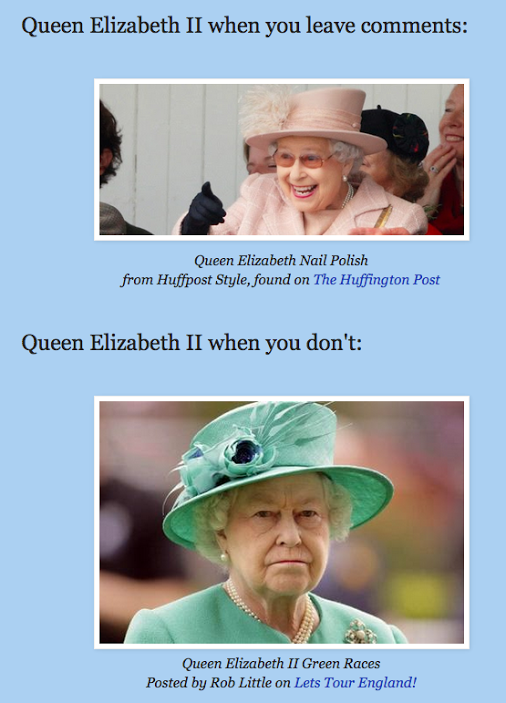
Comment Walls. Some students come up with fun graphics for their Comment Walls (they are setting up those Comment Walls this week, getting ready for comments to come). Here's one that is very fun indeed:


February 8, 2015

February 8: OpenTeachingOU News Update

So, I feel all the more strongly about my #OpenTeachingOU experiment after reading the Babson report this week. If the majority of people in higher ed still believe that online courses are not "legitimate," then those of us who KNOW otherwise need to share what we know as openly and as widely as possible. So, I will carry on with #OpenTeachingOU as my hashtag at Twitter,while also collecting #OpenTeachingOU from Google+ and my blogs over at the #OpenTeachingOU Omnifeed. (Thanks, as always, to Inoreader for that fabulous tool!)

Below is my #OpenTeachingOU round-up for this week, and you can find previous round-ups here too. I am really pleased that I managed to tag at least one item every day this week, and the beginning-of-semester rush has settled down, so I can hopefully start reading more widely. I am badly behind on people's blogs, but blogs are patient: in the coming week, I will try to catch up on some of my favorites.


OU Folks

Youth Community Informatics Studio. Wonderful, very informative blog post from Colin Rhinesmith about his new community-engagement course, "Leadership in Information Organizations" where they are working with the Moore Public Library. It sounds exciting!


Adentures in Digital Humanities. The open set-up that Katherine Pandora is using for this "dream course" means there are new things we can all see and learn about every week. The group blogs, for example, are up and running!

What is Your Motivation for Learning? Very useful post from College of Liberal Studies about students and motivation. I like the idea of thinking about motivation from different angles... because it's true: different students are differently motivated, as are teachers too of course!

PRPubs Pinterest. At Twitter Adam Croom shared a Pinterest project that is part of his PRPubs class.

I would be glad to know of other examples of open teaching going on at OU this semester!


Beyond OU

Bad News for Online Learning in Annual Report & “Unsustainable” MOOCS are Full Steam Ahead. You will find lots of write-ups of the Babson report data, but the one that got to the issues that most concern me is this post from Debbie Morrison.

Online Teaching: A New Beginning. And here's a nice counter-point to the Babson report: a guest post at Michelle Pacansky-Brock's blog about an online instructor's explorations and discoveries.

What Are Your Favorite Faculty Development Blogs? I was so glad to see Debbie Morrison and Michelle Pacansky-Brock on this list from the Chronicle's ProfHacker blog, and I look forward to exploring and finding more!

Desperately Seeking the Unique Pedagogical Characteristics of Face to Face Teaching. Excellent post from Tony Bates turns the Babson report upside down: instead of asking online to prove itself, he is asking defenders of face-to-face to please explain just what exclusive claims they have to teaching efficacy. 

Coursera Sets Sights on Universities. Yes, the megalomania at Coursera never stops: they still want us to believe that their courses are so good that universities can use them instead of teachers. I kid you not. No need for in-house expertise. Just buy Coursera. Ka-ching.

Instructure Releases 4th Security Audit. This is not about teaching but it is a nice write-up from Phil Hill about the importance of transparency, and I think it is no accident that Instructure is being transparent about its security audits, just as Instructure built an LMS that allows instructors to decide whether their content is open or not.

Ford Foundation, Open Access and Really Sharing Knowledge. Excellent post from Nancy White about openness, something to read together with Phil's Instructure post above. As I see it, the closed design of D2L, where instructors cannot share their teaching or their teaching materials even if they want to do so, is probably the single biggest barrier to our pedagogical progress. So, again: another reason for #OpenTeachingOU. We've got to get out of the D2L lockdown and start sharing more online!

Does It Matter Whether Students Recognize What We Do As Teachers? This post from Pernille Ripp also reinforces my sense of why OpenTeaching is so important: it matters to our students too, perhaps more than any other audience! 

What if Contentment is the Answer? Beautiful post from John Spencer about how contentment can lead to more and better risk-taking: confidence, not complacency.

How Medium Is Building a New Kind of Company with No Managers. Lots of good analogies for education here: this reaction against dehumanizing styles of business management would also work very well as a reaction against dehumanizing education styles as well.

Engagement: I Do Not Think It Memes What You Think It Memes. Very thought-provoking post from Terry Elliott about engagement as something that must be reciprocal and not just stimulus-response (a bit like my post about interaction from last week... but with better memes, ha ha).


My Stuff

Storytelling Posts. I really like being able to share the student blog posts in a dedicated stream; this week I shared the stories coming in from the Myth-Folklore class. I also shared their reading diaries, and it is the stories in those diaries that provide the raw materials for their storytelling later in the week. Coming soon: the Storybook websites are taking shape for this semester, as are the Portfolios!

Spring 2015: Grace Period Reminder Tracking. This is the blog post where I'll be providing an overview of my "little data" experiment for this semester, trying different interventions with students who are chronically late with work for class. The post is updated now for Weeks 3 and 4.


And as an image this week, I wanted to share this great painting of a "colporteur" (17th-century France).  It showed up in one of the book-oriented Twitter feeds I follow, and I thought it was beautiful: I feel like a colporteur for my students, singing the praises of the books... but the books I offer are free! Whoo-hoo! Long live the public domain and the open Internet!


February 1, 2015

February 1: OpenTeachingOU News Update

So, as last week, I'm using my #OpenTeachingOU omnifeed to pull together my teaching/learning highlights for the week! It would be so great if more people at OU started using this hashtag to share their teaching practices in an online conversation, but even just as a tag that I use for myself to put tweets and posts into a dedicated stream, it's very useful! (And here are my previous news round-ups.)


OU Folks

Katherine Pandora. The big open teaching news this week at OU was all the great sharing that happened via Twitter because of Katherine Pandora's dream course and the visit by Michael Peter Edson from the Smithsonian. You can follow Katherine at Twitter for more goodness to come, and, even better, you can visit the open class site: adventures in digital humanities.


Stacy Zemke shared this photo of the event via Twitter:


Beyond OU

Are Schools Failing Extroverts? Great post from John Spencer on extroverted students. As an "ambivert" (ha ha), I really appreciate how the online environment can be GREAT both for extroverts and also for introverts!

FUN: The One Thing We Forget to Plan For. Wonderful post from Pernille Ripp about fun. Sadly, so much of college teaching proclaims its rigor. I vote for fun! "Learning should be fun. Curiosity should have a place in our classrooms. Laughter should happen on a regular basis. Smiling should be a classroom rule. Fun should be one of the many pillars that supports all of the learning that we do. It should be embraced, discussed, worked on and celebrated. Schools should be filled with fun."

Questions to Ask Oneself While Designing Learning Activities. Such a great post from Jackie Gerstein and, yes, fun is one of the questions!


Helping a Perfectionist Child Worry Less and Do More. From Jessica Lahey at New York Times - I would guess that perfectionism is probably the single biggest barrier to changing how we teach... and it's also the biggest barrier to Open Teaching I suspect. A lot of academics don't want to share things openly that are less than perfect. That's not a problem for me, ha ha — I'm a recovering perfectionist, and my recovery is going very well.

A New Twist to Teaching Online: Considering Learners’ Emotions. Great post from Debbie Morrison. The emotional factor is HUGE in my opinion, which is why I find the idea of teaching machines laughable (and computers don't get the joke either). Debbies includes this very nice graphic from Rienties and Rivers:


10 Things the Best Digital Teachers Do. From Jesse Stommel over at Chronicle Vitae (which does NOT have RSS, alas)... a very good list! I esp. endorse this one: GRADE LESS. Or, even better, not at all; here are my thoughts on grading.

High Impact Online. Although I was dismayed by the idea that someone as savvy as Matt Reed had no idea what would be a high impact practice online, people chimed in with lots of ideas. I even left a couple comments there because this is such an important topic. As a result of a follow-up convo at Twitter with Debbie Morrison, I learned this great acronym: HIP, high-impact practice. I want to be an online hippie, ha ha, a "high-impact practitioner."


My Stuff

What Professors Actually Do. My response to Scott Walker of Wisconsin: if we practice OPEN TEACHING, then people would have a much better idea of what professors actually do. Especially those of us (instructors, not professors) who teach full-time!

The Potential of Online Education. Thoughts on face-to-face workshops. I just don't see how we will become confident and skilled at helping students to learn online if we continue to do all our learning in small, face-to-face groups. At my school, we are well into the second year of a big "Digital Initiative," but I have yet to see anything like a community of practice or learning network emerging for those of us who are committed online educators, eager and ready to share ideas, experiences, etc. The learning opportunities we offer faculty are all face-to-face, not online. For why this matters, see next item:

Course Evaluation Data: We're Skewing Low, Not High. And here are some numbers that demonstrate WHY those of us who are teaching online need to be sharing our ideas and experience: the course evaluations for online courses in my college skew low rather than high. In my opinion, the incredible potential of online education would mean the numbers should skew high, not low... but that is not going to happen until online instructors themselves start sharing and learning together online IMO.

Interaction Entre Nous... NOT Machines. My thoughts on the word "interaction" as prompted by a thought-provoking back-and-forth with someone in my campus's IT department.

New "Comment Training" Strategy. I am SO HAPPY with how this "Comment Training" experiment is going so far. It's something I wish I had done years ago in my courses!


And to close... here's a wonderful graphic making the rounds on Google+:

Change. If you don't like change, you're going to like irrelevance even less.


January 31, 2015

Interaction Entre Nous... NOT Machines

This blog post is prompted by a back-and-forth I had via email with a really nice person in my campus IT who wrote to ask me what I thought about a particular elearning authoring vendor. I wrote back to say that I didn't think much about the vendor (Versal) one way or another because authoring content was not something that interests me. Instead, I am much more interested in my STUDENTS as authors and designing classes in which the goal is to enable and encourage the students to be creating new, original content as part of the class. As a result, I think my time is better spent helping the students to create content, as opposed to creating content myself.

And here's what prompted this blog post: the very nice IT guy wrote back and said, "I think your focus on the student is correct although I've had at least a few faculty approach me with an interest in making their lessons more interactive."

ALARM BELLS RING: Interactive... do we all agree on what that word means? Clearly not.

To me, interactive means human beings interacting with each other. Inter-action. You do something, I do something that is somehow connected to your action: we are inter-acting. It is something that humans do together, and it requires humans to do that. Or, okay, cats. My cats are definitely interactive; they interact with me, they interact with each other (not nicely, alas).

But I do not believe that computers can interact with humans. We can use computers for all kinds of purposes, and one purpose of a computer can be to facilitate interactions with other human beings . . . like right now: I write something in a blog, and if you are prompted to comment here, and I comment back, glory hallelujah: we will have interacted, even if we have never met face to face.

But I am not prepared to use the term "interaction" for a computer's action in response to something that I have done. There is NO ONE THERE to interact with. If you say a computer is interactive because it makes a happy bleep when I answer a quiz question correctly would be like saying that Rice Krispies cereal is interactive because it goes "snap, crackle, pop" when I pour milk on it. Or like saying that the door to my house is interactive because it opens when I turn the key. And so on, ad infinitum ... and ad absurdum.

So, yes, it is essential that learning be interactive: we need human feedback of all kinds to keep our learning process moving forward. Making my online classes highly interactive is a primary goal for me. Just today, I wrote up notes on an important new strategy I am trying to improve the student-to-student interactions in my classes: New "Comment Training" Strategy.

But that does not mean I need an elearning vendor to sell me some product to create so-called "interactive" quizzes, etc. (scare quotes intended). Instead, I am interested in products that facilitate person-to-person communication online. Right now, for my classes that means mostly blogs and Twitter, along with that vintage standby: email. (I far prefer blogs and Twitter.)

So, what say ye, people? Has the word interactive become so empty of meaning that online quizzes now qualify as an "interactive" component of a class? Was the word "dynamic" not good enough? If so, heaven help us. It means I will have to find a new word to use for what I consider real interaction, if that word has indeed been kidnapped and emptied of meaning by the elearning vendors.


January 25, 2015

January 25: OpenTeachingOU News Update

Okay, it is always a colossal effort to get a new class up and running every semester. I keep making changes to the course materials (the students keep giving me so many good ideas to try!), and then there's the real effort: connecting with and getting to know all the new students, helping them to get online and start blogging, etc. I'm amazed and happy at what we have accomplished in the past two weeks, and I think the students are also very pleased — as usual, for almost all the students, it is the first time they have had a blog, and that really can be exciting... I still get excited when I make a new blog after all those years!

All that work, though, really wrecks the rest of my online life: reading, writing, keeping track of things. Luckily, though, I put a new content development plan in place that has kept me more-or-less on track, so I am REALLY happy about that. Even in the midst of all this work, I've made huge progress on the Indian Epics UnTextbook, and I've kept on publishing stories at Ocean of Stories (I finally got started on the jataka part of that project just yesterday), and I've managed to carry on with the Bestiaria Latina faithfully. At Twitter, I'm being really diligent about keeping up with following OU people (but I have not really kept up with anything else), and I've done a good job with the class Twitter stream too. In the blogosphere, I am hopelessly behind, and I have barely been keeping up even with what people are sharing at Google+. Luckily, though, both Twitter and Google+ are very forgiving and starting this week I should be able to get back into the swing of things!

What may save me, though, is this use of the #OpenTeachingOU hashtag. I'm not able to write up a news round-up today (I'm too far behind!), but I can do an #OpenTeachingOU round-up... which is better than nothing ha ha. Meanwhile, you can watch the #OpenTeachingOU feed over here on its own page, thanks to the power of the Inoreader omnifeed: Laura Gibbs - #OpenTeachingOU.

So, in order to write this OpenTeachingOU round-up, all I have to do is scroll through that HTML clippings feed, grab the best items, and add a little context. Even in the midst of chaos, that is something I can manage to do, and I think I've had #OpenTeachingOU stuff every day. I really didn't intend the use of this hashtag for my own housekeeping, but it has sure proved very useful for that. And, thanks to Cody Taylor this weekend, I am hoping that maybe ... maybe ... other OU folks will start using it as well!

Meanwhile, the notes below go back to my very first use of the hashtag. Maybe I'll be able to do bigger/better news round-ups as the semester settles down, but if I can manage to do this in the midst of chaos thanks to the hashtag, that's good enough for now. :-)

OU News:

Thank you, Cody! I was so excited that Cody Taylor used the #OpenTeachingOU hashtag for a post, and very appropriately since it was re: the very generous way in which Katherine Pandora and the DH crew are putting course materials online! (see next item)

Katherine Pandora Digital Humanities Intro. At Twitter, I learned about Katherine Pandora's DH class. Very exciting: course materials, group blogs, student blogs... such a fantastic use of create.ou.edu!

PR Pubs Goes Online! Another other great create.ou.edu experiment I learned about via Twitter is Adam Croom's PR Pubs course. You can read details here in his blog.

David Vishanoff. And via Twitter I learned about David Vishanoff blogging and teaching in the open: yes!!!

OUTechExpo. This is a link to the Twitter stream for OUTechExpo... not much Twitter, but something is better than nothing. Will the Jim Groom magic last? Will it have pulled some people into the world of open? It was Jim's visit to campus that prompted me to start using #OpenTeachingOU...!

Beyond OU:

Dealing with the Blog Flow. Fantastic post from Alan Levine about blog flow management. So fascinating to hear how other people work with this! A note about my blog workflow here and here.

How Interactive is Your Online Course? Self-Assess with this Rubric. Very helpful post from Debbie Morrison.

A shift in education: Teachers who create content, not consume. I learned about this great blog post (interview with Stephen O'Connor) via Twitter.

New Feature at Wikimedia. Helping to raise people's awareness of image sources, licenses, and citations.

21st Century Skills and Attributes
. A nifty self-assessment from Jackie Gerstein.

9 Barriers to Personalized Learning And How We May Work Around Them. Very powerful and useful post from Pernille Ripp.

Modern Learning Routines. Great graphic from Silvia Tolisano via Twitter:


Teaching and Scholarship. I loved this quote from Jesse Stommel at Twitter: The scholarship OF teaching should not be limited to scholarship ABOUT teaching. Teaching is itself scholarly and a product of research.


Teach While You're At It. And on that subject, Stephen Landry has a very nice piece about teaching and research in the Chronicle.


My Blog Posts:

Indian Epics UnTextbook: Table of Contents Emerging. I am going to try to do a better job of documenting the UnTextbook this time around, esp. since I learned a lot from my mistakes with Myth-Folklore UnTextbook last time! :-)


Hashtags for curation: Saved by #OpenTeachingOU. More about this hashtag thing is working for me.

Martin Luther King Day Edition. I spent most of the day on Sunday learning more about Martin Luther King in honor of Martin Luther King Day on Monday... and making quote posters — and I ended up with about 50 of them! My favorite quote: We must always maintain a kind of divine discontent. — Martin Luther King, Jr.


Ten Reasons for Week Zero (a.k.a. Soft Start). Wow, Week Zero seems like forever ago! But here is a blog post about how important it is.


My Google+ Quasi-Blog:

Siren Song of the Deadline. Thoughts on student autonomy, and lack thereof. The ringing of the bell: Pavlov warned us about that, didn't he???!

Indian Epics Overview. I am super-happy with the changes I made to this Overview activity in Indian Epics; results so much better than last semester!

Writing Assessment: Spring 2015. The ritual update from yours truly about how the proofreading assessment went this semester. Very consistent with past semesters and, as always, I am glad to have engaged with the students re: this dimension of the class already in Week 1.


Peer Comments. I'm trying out a new series of assignments to help students develop better commenting skills. So far, so good with the first assignment!

Reading Diaries: Happy Update. I'm really pleased with tweaks to reading diary instructions. Overall, diaries definitely better this time already starting in the first week of reading: more reflection, less plot summary.

UnTextbook Reporting. And the Google Form with student feedback on the UnTextbook is filling up... with the new extra reading option, I should get feedback on a lot more units this semester!

Why I Love My Job. Just one of many great moments thanks to student blog posts... and also here and here.

Helping Students with Blog Post Images. Yes, it is worth getting into the nitty-gritty of details like this students, esp. when they run into problems with broken images as a result of remote linking.

Inoreader Update. I am SO PLEASED with the way Inoreader now updates items. That is a huge help with my students, esp. as they are revising blogs early in the semester in process of learning ins-and-outs of blogging.

Pinterest Experiment. Update on Pinterest experiment: going great!

Reading a Powerpoint Aloud. Extended and very lively discussion erupted at G+ from Stacy Zemke's share of this meme!


Notes from the Twitterverse:

Tweets about Pinterest experiment: here, here, here, etc.

Tweets about D2L Twitter widget integration: here, here, here, etc.


January 20, 2015

Hashtags for curation: Saved by #OpenTeachingOU

Well, it is time to pause and say: WOW!!!!!!!!! The semester has gotten off to a fantastic start for me. I am seriously overenrolled in my classes (usually about 10% of people who are enrolled drop, and I plan on that... but, yikes, that has not happened this semester, so I am still at over 90 students right now)... but thanks to Inoreader and other improvements in my work flow, I think I should be able to cope. And it is going to be so exciting having all these people blogging, writing stories, sharing ideas. So many great students as always.

But........ BUSY. That overenrollment is definitely going to eat into the time I might normally have available for blogging and stuff.

Which is why I am so glad that I started using the #OpenTeachingOU hashtag.


In honor of Jim Groom and the Academic Tech Expo we had here earlier this month, I started using an #OpenTeachingOU hashtag at Twitter, at Google+, and also at my blogs, hoping that might be a way for those of us who are into open teaching to connect up with one another. That has not happened yet (although there was a seriously awesome post from Adam Croom in that spirit!) ... but even just using the hashtag for MY OWN CURATION has proved really useful. I haven't had any time to do any posting at this blog for the past week or so, but the #OpenTeachingOU hashtag does provide a glimpse into what I am thinking about and how things are going this semester so far!

I've created an #OpenTeachingOU OmniFeed page which shows all my posts with the tag (Google+, Twitter, blogs... and Pinterest too... although I don't think I've pinned anything for open teaching yet), and you can also see a standard Twitter hashtag widget in the sidebar of this blog. Isn't that cool? I love the way I can create these "omnifeeds" with Inoreader thanks to their Google+ and Twitter integration!

So, for those of you who are not interested in my Latin LOLCats and stories from India and random blah-blah-blah-whatever that shows up in my feed, the #OpenTeachingOU Omnifeed is for you, ha ha. It is a glimpse into my teaching eurekas... and a promise of blog posts to come.

Hashtags: they are powerful!

And I saw this infographic about history of hashtags thanks to Ian O'Byrne over at Google+ today. To be honest, hashtags kind of suck at Google+ (even if I am one of Google+'s biggest fans)... but I do use #OpenTeachingOU there too, in hopes that Google+ hashtag culture might improve.

And someday........ someday.......... I will get up on all the posts I am behind at this blog, ha ha.


January 10, 2015

Ten Reasons for Week Zero (a.k.a. Soft Start)

So I just had such a nice week!!! It was "Week Zero" of the semester; in other words, classes start officially on Monday (Jan. 12), but I opened up my classes a week early (on Jan. 5) so that people who wanted to get a head start could do so. This is something I have always done from teaching online, from the very first semester back in 2002. I recently posted here a list of Ten Reasons for Orientation Week, so I thought it would be good to do a list of Ten Reasons for Week Zero (a.k.a. Soft Start).

1. Helping students get ahead. Working ahead is one of the best strategies for any class, and that is especially true for online classes. It is consistently the top advice that students recommend to future students, as you can see here: Peer Advice - Time Management. Having the classes open in Week Zero is all about getting ahead!

2. Taking advantage of slack time. Once students' other classes start, I am competing for their attention. Because I teach Gen. Ed., my class is understandably not a high priority for many students; classes for their majors must come first. So, if I really do want these students to get ahead (see reason #1), then taking advantage of the slack time before the official start of the semester is really important!

3. Making sure students know what they are getting into. Not all classes are a good fit for all students. My classes, for example, are writing-intensive, which is not something students expect from a Gen. Ed. class. By opening up the class early and encouraging students to give it a try or at least to see the course materials/assignments, they can see what they think. If they decide to drop, they will obviously have a better chance of finding another class to add instead if they are looking in Week Zero as opposed to looking for an open class in Week One or, worst of all, in Week Two, when you can only add with instructor permission.

4. Checking to see if the courses really are ready. I am so grateful to the students who alert me to broken links, instructions that are not clear, etc. The more I tinker with the courses (and over this winter break, I tinkered way more than I usually do over winter break — there were just so many good ideas from students last semester that I wanted to try out!), the more likely that there will be typos, broken links, etc., that I need to fix. I really depend on the pioneer students during Week Zero to help me find the things I need to fix!
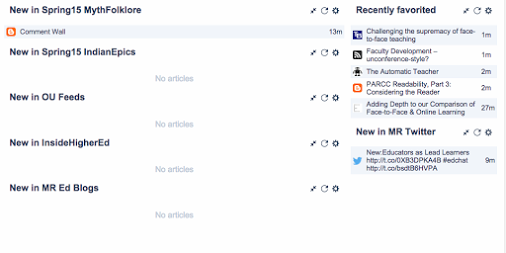
5. Refining Inoreader folders, rules, and labels. By having incoming blog posts from the students, I am able to make sure my Inoreader folders, rules, and labels are going to do what I need them to do. Last semester, I found Inoreader too late to do a really efficient job with the rules, but I learned a lot from my mistakes in order to set things up more efficiently this time. Of course, I thought I had it all figured out... but when actual student blog posts started coming in this week, I realized lots of little tweaks that would help make my folders, rules, and labels work even better. I need actual student blog posts in order to match the workflow to reality!

6. Bringing the class blogosphere to life. Not only do the live blogs help me in configuring Inoreader, it is also a big boost for the students who who will be starting the class next week: they can see the posts that students wrote in Week Zero, and seeing actual examples of the assignments is just as important as the instructions I provide. Indeed, for some students, it's even more important because they might just skim the instructions, getting their real sense of how to do the assignment by looking at the work of others. Thanks to Inoreader's rules and feeds, I can automatically share those assignments; here, for example, is the first blog post assignment: Favorite Place(s). I love the way it updates 24/7 automatically as the blog posts come in!

7. Getting to know the students. I love the way I have time to read and respond to all, or almost all, of the blog posts during Week Zero. That is less true in Week One, and then in following weeks, it's the students replying to each other mostly, with the blogs being more "their" space in the class while I focus on their projects. During the soft start, though, I have a chance to really get to know the students who start early, reading all their work, getting a sense of who they are, their goals for the class, etc. It is always such a pleasure: my students are a fascinating bunch, and I really like having time just to get to them know them in a more leisurely way during Week Zero. This week during Week Zero, appx. 40 students set up their blogs (but not all of them have started posting in their blogs), and I made 87 comments on actual blog posts.

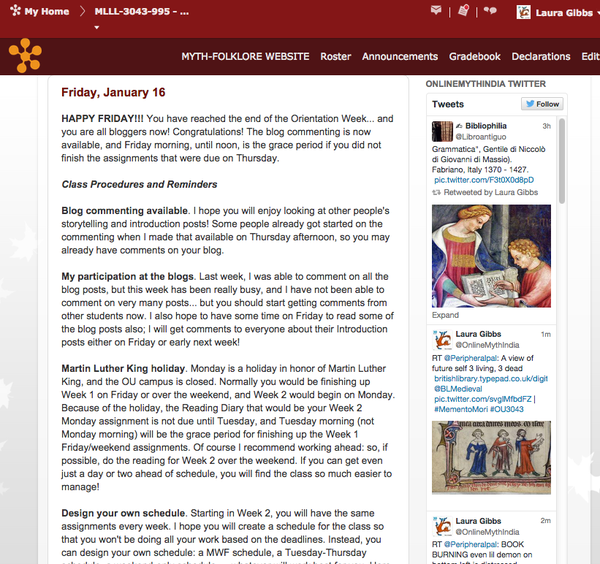
8. Setting up lines of communication. When I release the classes to the students, I start using the different channels of communication that we will be using all semester long, so the students can begin getting used to that, even if they aren't doing work for the class. So, I start posting in the Announcements blog, I revive my class Twitter feed, I start pinning regularly to my class Pinterest Boards, etc. In most of the classes at my school, the focus is 100% on D2L BS (our course management system), but for my classes, D2L BS is not important at all for the content or communication in the class, and I want the students to be aware of our Class Announcements blog, the different websites I use the class, etc. So, the emails I send them about the soft start are not lengthy emails. Instead, they are just a few key links to get them started — link to the Class Announcements blog, link to the class websites, etc. Not D2L.

9. ENTHUSING. One of the most important ingredients for success in my classes is enthusiasm: the students' enthusiasm and my own enthusiasm combined. By starting the classes early, I can demonstrate and share my own enthusiasm with the students, hoping to be a catalyst for some enthusiasm on their part — and my enthusiasm for these classes is ENORMOUS... even though I have fun during the school break, I am always so excited to get back to work and make sure the classes are ready to go.

10. Getting myself into school mode. I love my job, but I also love the holiday vacation. I stay up too late, watch too much Netflix, read mountains of stuff, start new projects, indulge my own obsessions without restraint. Luckily for me, some of those projects and obsessions are school-related, but there's still a HUGE difference between my daily routine when school is in session and when it's not. Having the soft start is a way for me to make that transition so that when the craziness of Week One arrives, I am ready for it! Well, sort of, ha ha.

... yes, I do get up early when school is in session! Here is a rhyming Latin proverb on that subject.


(Latin: Est sanum plane de lecto surgere mane.)


'


#OpenTeachingOU 

Update on #OpenTeachingOU Hashtag: Happy!

So, just a quick post here to say that I am really happy with this hashtag I have started using, #OpenTeachingOU. Given the hectic time at the beginning of the semester, with all the work I'm doing to get ready for classes, I haven't had time to be keeping up with my news rounds-ups, etc., but the #OpenTeachingOU hashtag is a way that I can label tweets and posts and items at Google+ so that they don't get lost in my online space which is full of teaching stuff, yes, but also full of LOLCats and Indian images etc. etc. So, the hashtag is proving to be a really good way for me to think about open teaching as I participate in these online spaces each day, and that is a good thing to be thinking about!

I'm also REALLY grateful to know about the ClassicRetweet extension for both Chrome and Firefox since that allows me to add the hashtag when I retweet. :-)

Of course, most of all I am hoping... especially after Jim Groom came and worked his magic at the Tech Expo on Friday... that the #OpenTeachingOU hashtag might catch on! There are all kinds of people and programs at OU that are moving, slowly or quickly, in the direction of open teaching and connected learning, so in addition to just using it for my own curation purposes, I'll also keep hoping that the hashtag will serve a more social purpose too.

Below is the HTML clippings feed for the #OpenTeachingOU hashtag via Inoreader (see it on a page of its own ... and here's the RSS). That's a bit different than the widget in the sidebar of this blog: in the sidebar, you are just seeing the Twitter stream for the hashtag, but Inoreader is pulling anything with #OpenTeachingOU, which means all the blogs I am subscribed to, plus my Google+ stream, along with Twitter. Inoreader searches through all that stuff with a rule I created, and then it combines the matching results into a new consolidated RSS feed.  Plus, I can add that label manually to items I find in Inoreader myself if I want to pull them into the RSS feed for OpenTeachingOU. So powerful! I am really enjoying the different uses I find for Inoreader, and this is a good one. :-)


January 6, 2015

A fun first day with #OpenTeachingOU hashtag

Hashtags are one of my favorite things about Twitter. They are great for indexing AND great for connecting. I'm not sure if it will be possible to get #OpenTeachingOU to really work for connecting people at OU (there are just not that many OU faculty using social media, alas...), but even if it is not something that takes off in a social sense, I realized yesterday how useful this can be for me simply as an indexing strategy.

#OpenTeachingOU

Here's what I mean by that: as I tagged my own content yesterday and also used #OpenTeachingOU when I retweeted and shared at Twitter and at Google+, I was able to focus more clearly on what part of my content stream is about open teaching. Open teaching is something I care about very much, and it can go in so many different directions: open syllabuses, open educational resources, sharing narratives about our work as teachers, sharing our students' work, and on and on. Connected Courses really affirmed my commitment to open sharing online, so I will be hoping good things for open everything in 2015!

In particular, I'll keep hoping good things for online conversations about teaching at OU in the new year (more about that here in my previous OpenTeachingOU post), and I'll also enjoy having the #OpenTeachingOU hashtag as a way to index my own blogs and tweets and posts.

So, after Day One, here's how it is looking at Twitter: #OpenTeachingOU ... and thanks to the power of Inoreader to turn all kinds of things into a feed, you can see even more via the Inoreader RSS or the HTML display for the tag! I've embedded that HTML view below. Just click on the title of any item, and away you go!

Next: I need to add a Twitter widget for this hashtag to this blog's sidebar. Hashtags! Widgets! RSS! Connect and share everywhere! Yes!!! :-)


January 4, 2015

#OpenTeachingOU hashtag ... high hopes for 2015

Connected Courses was an experience that really helped me to re-commit to open: open courses, open teaching, open learning materials... open everything! In the spirit of open, I'm going to start using an #OpenTeachingOU hashtag at Twitter in the hopes that I can connect with other people who are also interested in sharing their teaching knowledge and experience with others. Will that maybe take off...? I'm thinking that would be pretty cool!

#OpenTeachingOU

It seems like this would be something easy to promote via OU CTE (Center for Teaching Excellence) and maybe the Academic Technology blog, too. It could also be something to bring people together in online course program in my college (since open teaching is of special importance to online instructors, making things up as we go along, pioneers in a new world), along with people in other online course programs at OU, like Liberal Studies. It could even be of interest to the OU Writing Center (those of us who really work on the teaching of writing can help each other in so many ways), and of course it connects with the great work that is happening in the OER initiative through OU Libraries.

In all the years I have been at OU, there really has not been much conversation about teaching that has happened in the open; instead, those conversations about teaching happen in departmental spaces, person to person, and also in face-to-face workshops which are the only kind of faculty development that I've seen at OU over the years. Face-to-face has its advantages to be sure, but it also has some serious limitations also. If we want to promote long-lasting, wide-ranging conversations about teaching, especially conversations that reach across departments and colleges at OU, and which can also involve our colleagues at other schools, well, we really need some online conversation, too!

So, I'll be using that hashtag at Twitter, and thanks to the magic of the "Classic Retweet" extension, I'll try to remember to retweet with that tag when I find posts from OU folks that are about open teaching. I'm doing my best to keep up a list of OU faculty at Twitter. Who am I missing? Let me know! I also have a list of OU programs, departments, etc. at Twitter: again, please let me know what I'm missing here!

In addition, I'll try to maintain a steady #OpenTeachingOU outgoing feed with the magic of Inoreader; you can see the HTML clippings view, and you can also subscribe with RSS (Inoreader: it's magic!). With Inoreader-Twitter integration, that means I can pick up the Twitter items there too by creating a rule for that. In fact, I'll go grab some open teaching tweets and blog posts from OU folks and tag them in Inoreader! (pause) Success: it was fun grabbing items in Inoreader to add to that feed!

I really enjoy all the conversations I get to have about teaching in virtual spaces with colleagues at other schools, but it sure would be nice to have more OU conversations too. Twitter has been a great way to connect with OU people, and I hope I can make good use of #OpenTeachingOU as a hashtag to help us connect and share even more in the new year to come. We all have so much stuff to share! Open the doors, everybody!